Monday, April 12, 2010

Officials take an interest

On the 23 October 2008 Mark Canning from the US Consulate in Cape Town visited Lwandle Museum along with Sisa Ngondo and other representatives from the City of Cape Town who have supported the Lwandle Museum in numerous ways.

Museum curator Lunga Smile and Board Members Leslie Witz and Noeleen Murray met the party at the Museum which was followed by a walking tour (without Leslie Witz who was injured!) before returning to the Museum to find out out more about U.S Ambassador's Fund for Cultural Preservation which the Museum and the City (as the land owners) were keen to know more about.


Lunga Smile takes the party through the exhibtions in the Old Community Hall.
All photographs Noeleen Murray.


Seeting out on the walking tour. ( Left to right Sisa Ngondo and CCT colleague, Lunga Smile, US Embassy visitor and Mark Canning).

Mark Canning was instrumental in informing the Museum of the Ambassador’s Fund for Cultural Preservation that his country had set up. Following this visit the Lwandle Museum set about making an application to this fund, with the aim of restoring Hostel 33, which by this time was beginning to need repairs which the Museum could not afford. The Museum was however mindful of the international competition and received the news of its nomination as the South African entry with great excitement, which was amplified when the final announcement came that Lwandle migrant Labour Museum’s application was granted the award internationally.


Standing outside the fast deteriorating Hostel 33 building.


Lunga Smile's accounts of hostel life inside Hostel 33 , with Mark Canning (left).

Without this substantial grant and the support and enthusiasm of the U.S Consulate in Cape Town - Mark in particular - the restoration of Hostel 33 would in all likelihood not be happening.

For more information about the Fund see: http://exchanges.state.gov/heritage/afcp.html

Securing Hostel 33 for the museum purposes

When the Lwandle Migrant Labour Museum was initially conceived of it was only Hostel 33 that was intended to be the museum. However, the museum had been unable to take possession of Hostel 33 as there were people living in it and alternative accommodation had not been found for them either in the Hostels to Homes project or in the RDP houses that were being built in Lwandle. The museum could not evict the residents but it did suggest that they place themselves on the waiting list for new houses. They did this, but for several years those living in Hostel 33 were not allocated new housing in Lwandle. Visitors to the museum (which had relocated to the Old Community Hall in Vulindlela Street) were still taken to Hostel 33 but with permission of those residing there.

By January 2007 the situation had altered. Some of the residents of Hostel 33 had been allocated houses but once they had moved out a new group of young people had moved in without the permission of the museum. The museum had no authority to evict the new inhabitants but the curator was directed by the museum’s board to put up a sign indicating that the hostel was the museum’s property. Although this was done the youth took little heed of this. Problems continued to mount and it was reported from the neighbours that criminal elements were operating from the hostel. Evidence of the number 28 painted in one of the rooms is an indication that these reports were accurate. This is a number of one of the gangs that are formed in South Africa’s prisons. In the end the museum board decided that to ask Xolani Sotashe (the Lwandle councillor) to assist. Together with Cllr Sotashe the museum staff undertook some difficult and sometimes dangerous negotiations with these youth. Ultimately in June 2007 they vacated the premises. The museum, for the first time since opening was actually able to take possession of the hostel and secured the premises with a gate and a lock.


28's gang image painted onto the walls of Hostel 33.
Photograph by Noeleen Murray, February 2010.

Women’s Month of 2007 provided the ideal opportunity to formally mark the possession of the Hostel 33 by the museum. In choosing this moment the museum was signifying that despite the fact that under apartheid these hostels had been established as male spaces, from their inception women had stayed in the hostels. They had been subject to considerable harassment as under the laws and regulations of apartheid these women were illegally in Lwandle. It was also fortunate that at the time in 2007 Nungu Nungu, a student from the African Program in Museum and Heritage Studies, jointly offered by University of the Western Cape and the Robben Island Museum, was doing his internship at the museum. He came up with the idea to combine two events, the celebration of the Women’s Month and the securing of Hostel 33.


Nungu Nungu and classmates for the African Programme in Museum and Heritage Studies outside Hostel 33. 18 August 2007.
Photograph by Leslie Witz.

Nungu Nungu gave the title to the celebrations ‘Ubomi booMama emaholweni’
(Women’s Life in Hostels). The Women Ambassadors, who had been selected by the museum the previous year to publicize the activities of the museum to the community, were asked to decorate the Hostel 33 the way they remembered it. Lockers, beds, bedding, pictures from magazines, photographs, coat hangers and cooking utensils were all brought in an attempt to re-inhabit the hostel and depict their lives as they remembered it. On Saturday 18 August 2007, the group of women formally opened the doors to Hostel 33 and re-enacted elements of their lives. This included showing how a shebeen had operated in the hostel, how they made their lives around a bedstead and the ways they tried to deceive the police who were constantly raiding the hostels. Mrs. Kholiswa Ngcani, for instance, showed everyone how she used to hide away from police in the four door cupboard that was meant for luggage. One of the woman ambassador’s carried a small poster with the words that reflected on their conditions in the present compared with those that they had endured in the past. It read: ‘Lwandle today: a taste of freedom’.


Stories remembered inside the old hostel space, 18 August 2007.
Photograph by Leslie Witz.


Women re-enact a shebeen run from one of the spaces in Hostel 33. Soon after this image was taken a dratised police raid had on-lookers amazed as the women made themselves invisible by hiding in small spaces like cupboards, reminding their audience that women were of course not legal occupants of the hostels. 18 August 2007.
Photograph Leslie Witz.

Charette with the neighbours of Hostel 33, 12 November 2009

The Board of the Lwandle Migrant Labour Museum was excited when the architects from Jakupa and Associates, whom we had appointed to provide professional services for the restoration of Hostel 33, suggested to us at the inaugural client-architect meeting held on 1 October 2009, that the first phase in the process be a series of charettes. The initial one would be largely with neighbours of the Hostel, and then a follow-up with the board and staff of the museum. They explained that a charette could be seen as a type of gathering together of ideas, concerns and challenges in quite an open-ended and from there honing in on specific issues which emerged from discussion that related to the envisaged project. The word charette means a cart or barrow, and quite literally the concept is to throw the ideas into the cart to begin working out a design solution. From the charettes the architect’s brief would be developed. This opened up the possibilities for the close involvement of those living in Lwandle and near to Hostel 33 in the museum activities and contributing towards the remaking of Hostel 33. The minutes of the client-architect meeting also indicate that one suggestion made was that 'the charette process could be documented and form part of the museum display'.


Neighbours, Board and Staff of the LMLM gathered for the Charette.
All photographs by Leslie Witz.

Key to the success of the charette was ensuring attendance and participation. Lunga Smile, the museum's manger, spent days speaking to the neighbours of Hostel 33 explaining to them what was being envisaged around the restoration and how it was essential that they become part of the process. Carefully and in detail he explained and answered questions about how the museum wanted them to become stakeholders in the future of the hostel as a proposed heritage site. The results of his efforts were evident when the first of the charettes was held in the restaurant annex to the museum (a converted large container) on 12 November 2009. Approximately forty people from Lwandle attended the charette which was facilitated by Khalied Jacobs and Renchius van der Merwe from Jakupa and Lunga Smile and Masa Soko from the museum’s side.


Staff from LMLM and Jakupa seting up for the Charette.

Each participant was given three small cards on which they were asked to write briefly and anonymously what they perceives to be the problems or challenges associated with the proposed development of Hostel 33. Masa and Lunga assisted some of the participants with explanation, translation and writing their ideas, so that all could make their contributions to the discussion. These were collected and grouped on the wall of the container with the audience participating and clarifying the points they had made. This took longer than anticipated as the response was overwhelming as participants debated and challenged the ways their points were being represented and grouped as they were being placed on the wall. When the idea was expressed in isiXhosa Lunga or Masa would translate into English, with the enthusiastic help of other participants in the workshop.

Broadly the responses can be categorized as concerns with memory, preservation, cleanliness, security and jobs. Conserving the memories of migrancy for future generations was a major motivation expressed for the project. What the process of preservation entailed though was quite ambiguous. Some saw it as keeping the hostel as it was before and not being re-built while others wanted it tidied up and made beautiful. Preservation was seen to involve painting, clearing up the litter, repairing the door, installing electricity, fixing the ceiling and putting up pictures and curtains. Issues of security were a major concern, mostly aptly expressed in the term ‘iburglar’. Ideas were put forward ranging from installing burglar guards, ensuring that children did not throw stones and break the windows to putting up a fence around the hostel. Finally there was a concern that those who live in Lwandle would benefit from the project especially in terms of job creation, both while the restoration was taking place and when tourists visited the hostel.


Neighbours describe details of the hostel.

After the ideas were posted on the board the participants divided into two groups to discuss and draw on paper what their vision was for Hostel 33. In both cases what the groups tried to do was represent diagrammatically what they thought the hostels had looked like: the divisions into compartments (one group drew 8, the other 12), the heights of the walls between compartments, the location of beds, tables and cupboards, the outdoor bucket latrines, and siting of the two light bulbs in the hostels. In one group there was an indication of how the hostels had changed over time, with initially no separation between the compartments, then with residents installing self-made curtains and later making divisions by hammering together pieces of wood in a frame. The discussion around what to include in the diagrams was heated and energetic. As a result the workshop began to run over time and the Rise and Shine Dance Academy who use the venue to practice their ballroom dancing during the week decided to practice on the lawn outside the museum.


Schemes were presented showing ideas and drawings, which were discussed energetically as Lunga Smile (right) kept everyone informed with running translations.

At the end group presented their vision of the envisaged restored Hostel 33, as the participants argued about what should be added or excluded from the diagrams. In the case of both groups there was an attempt to present the hostel in realist terms, with claims to accuracy being paramount and, almost inevitably, highly contested. There was also a sense that change had to be central and that the different lives of various inhabitants of the hostel for the over almost 50 year of its existence needed to be incorporated. At the end of the first charette there no firm decisions had been made, but most importantly the neighbours of Hostel 33 were being informed about the process of restoration and were making a substantial contribution to it. Probably the most apt summing up was from Christine Makabane, a museum board member, who voluntarily attached her name to the suggestion she put forward: ‘Arise and Shine Hostel 33 After Aparteit’, she wrote.

Participants at the Charette wrote comments on cards which recorded their ideas.


Thursday, April 8, 2010

Lwandle in the 1980s

Image 1: 'Talking men'
All photographs by Andrew Bermann
In the 1980s Lwandle was under threat of removal to Khayelitsha. The Urban Foundation
commissioned a report at the time and ultimately Lwandle managed to resist removal. The images below were taken by Andrew Bermann as part of information for the the Urban Foundation's report (a copy of which he has kindly donated to the Lwandle Museum archive).
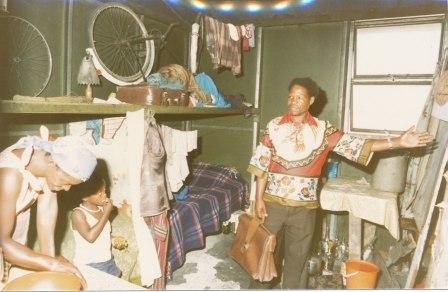
Andrew's account of the visit is interesting. A group including Basil Davidson, Andrew, Andre Penz and others were taken around Lwandle by the Hostel Dwellers Association. They were address in the Community Hall, now part of the Museum (see image below) afterwhich they were taken on a walk around Lwandle to spaces such as the kitchens, the ablution blocks, the dining hall, and individual hostels where people stayed. Andrew, whose passion is photography, describes that he only had his Leica 35mm camera, a flash and two rolls of film.
He cautioned that the photographs cannot be seen to be a comprehensive documentation of the place as it was a quick viist to select places. However the images are documentary - they were used to motivate against the removals in the report - and now provide an instructive resource for the Museum's purposes.

Image 2: 'On stage'

Image 3: 'Kitchen Men'


Image 4: 'Family Living'

Image 5: 'Eating Area'


Image 6: 'Cooking Area'


Image 7: 'Chickens'


Image 8: 'Bucket Toilet'

Image 9: 'Brown Pants'
The following two images were taken by Andrew subsequent to the visit when he managed to get to fly over the area.

Image 10: 'Aerial Near'


Image 11: 'Aerial Far'

Information communicated to Noeleen Murray, Rondebosch, 8 April 2010

Wednesday, April 7, 2010

Going on site - the bucket system area is cleaned out

Local contractors from Lwandle set about the work of clearing out the old bucket system area at Hostel 33.

Lunga Smile and Lundi Mama were there to record the careful process of removing years of rubble.


View of the only remaining timber remnant of a toilet seat was found.

Brickwork along the base is in bad repair, most probably because of the wet conditions caused by overflowing buckets over the years.


All photograph taken by Lunga Smile and Lundi Mama

In March 2010 Lunga Smile, LMLM's Curator, oversaw the cleaning out of the old bucket system area alongside Hostel33, along with a local contractor, Nqabakazi Ntoni.

This is the only remaining building in Lwandle after the Hostels-to-Homes project of the 1990s resulted in the conversion of the hostels into family units and the bucket system was replaced with waterborne sewerage facilities in the area.

Until 2010 the old structure was locked and used as an illegal dumping ground where people had thrown miscellaneous unwanted waste. As a temporary measure while people were still occupying the hostel (up until 2007 ) provision was made inside the Hostel 33 for a water borne sewerage bathroom, which is the only alteration that was made to the space since it was decided that it should become a part of the Museum.

After much debate, as part of the restoration, a decision has been made to remove this new bathroom and incorporate the story of its existence into the exhibitions around the Hostels-to Homes Project. The old bucket system area is however being restored as a key part of the story of migrant life in Hostel 33 under apartheid.

The images here show what the space looks like now that the Museum has gained access to the six - compartment bucket toilet spaces. Remnants of the stell supestructure for toilet seats are visible and there is a fragment of a rudimentary wooden seat.

Finding new bricks to match the old bricks


Image: Renchius van der Merwe

Correspondence from Renchius van der Merwe, Project Manager on-site for the restoration of Hostel 33:

' The following photographs show two typical original bricks (found loose and) taken from Hostel 33, and matched samples obtained from Corobrick Centre in Somerset West (off N2, next to CTM Tiles).

As far as I can tell, the exposed original bricks range between the two found samples, red to orange. The advice from Corobrick Centre (Mark Bonthuis) is that the original are plaster bricks (r.o.k / NFP/ stock brick), and that the sample bricks are the closest match that they have.

As you can see in the photo, the orange colour is more difficult to match, but the immediate problem is the size: the samples are (A) 73mm Autumn Paver, (B) 7MPa Yellow Plaster Brick, (C) original orange brick, and (D) 12MPa Red Foundation Brick.

My opinion is that we use the 14MPa Red Foundation Brick which is more hard wearing, and thereafter decide if we need to bag and paint, or leave it as it is.'

William Martinson has suggested that we investigate if there are not any other independent brick yards in the area. He thinks that a small coal fired operation might even be able to make a small batch to the correct dimensions.

David Worth may be able to advise on existing brick yards.


Existing sample from Hostel 33
Image: Renchius van der Merwe

Exploring the materiality of the building

Image courtesy: Jos Thorne
Images showing Hostel 33 when the wall at the entrance to the bucket system toilet area was still standing, images from the period in which Mbulelo Mrubata was Curator of the Lwandle Museum.

Image courtesy: Jos Thorne


Image courtesy: Jos Thorne