Friday, May 7, 2010

Hostel 33's restoration in considered alongside other debates over modern architecture's heritage worthiness in Cape Town


Image from an article published by Noeleen Murray in the Cape Times OpEd section, p11, Friday 7 May 2010.

Text from the article:

City structures still reflect the social divide

by Noëleen Murray

The effects of the emergence of the 2010 World Cup Stadium in the landscape of Cape Town have yet to be fully understood over time. Already in its immediate presence, through its modern approach to architecture, its massive concreteness, and set against the iconic backdrop of Table Mountain in the city, it has become the dominant global image of post-apartheid Cape Town.

As is well known from the debates that have recently circulated around its possible proposed locations in the city , this image has been carefully constructed to present a particular view of Cape Town to an international market of 2010 tourists. What is less immediately accessible from this image is the underlying presence of earlier forms of modern architecture in the city built during the years of apartheid. Many of these buildings are less easily transformed into tourist attractions in the post-apartheid city than the slick, technologically advanced modernism of the stadium, and yet their presence continues to affect the daily lives of people across Cape Town.

The effects of modern architecture and urban planning in Cape Town are now well-known and have a darker, more problematic and divisive history in the making of the apartheid character of the city. At the same time certain examples of Cape Town’s modernist architecture have long been considered by local architects as exemplary works of an international architectural design standard. It is perhaps not surprising then that, with the passage of time since 1994, certain modernist buildings are being considered for their heritage worthiness.

There are two striking instances of this in contemporary Cape Town. The first is located in Lwandle near Somerset West where Hostel 33 is being restored as part of the Lwandle Migrant Labour Museum. Hostel 33 is the only remaining migrant labour hostel designed by engineers in the local authorities as part of a compound for single males who worked in the Helderberg Basin and is a reminder of the oppressive policies of apartheid’s migrant labour practices in the city under the infamous Coloured Labour Preference legislation.

The second is the proposed redevelopment of the Werdmuller Centre in Claremont designed by architect and urban designer, University of Cape Town Professor Roelof Uytenbogaardt in the 1970s. Since the time of its construction this shopping centre has been controversial. Built in amongst the largely Victorian architecture of old Claremont subsequent to Forced Removals in the area, its modern architecture was hailed with affection in the 1970s by architects but less favourably received by the broader public.

In both instances the buildings under consideration fall outside of the cautionary sixty year clause contained in the National Heritage Resources Act promulgated in 1999 and arguments have had to be presented to the heritage authorities motivating for their heritage worthiness. What these two projects reveal is the complexity of the histories of their presence in the landscape of the city.

While their shared categorisation as works of modernist architecture is technically correct, as both Hostel 33 and the Werdmuller Centre were designed in accordance with internationally accepted principles of modernist design, albeit in different ways, their emergence in the local context and within the politics of the time in Cape Town are strikingly different. Hostel 33 was designed as part of a planned hermetically sealed off labour compound which later became a township space and the Werdmuller Centre was an individual building commissioned in the 1970s as a shopping centre in a newly formed White Group Area. In both cases the buildings were designed for racially designated Population Groups under apartheid.

The argument for the preservation of Hostel 33 in its original state is for the retention of space that memorialises a key spatial type manifest as part of the apartheid lexicon of segregation. Here the highly administered lives and traumatic conditions under which black men were forced to live in urban areas under the Pass Laws is remembered through the old hostel which is located in amongst the other hostels which were transformed into family accommodation under a ‘Hostels to Homes’ project in the late 1990s. In the walking tour at the Lwandle Museum, Cape Town’s first and only township museum, the hostel is part of a narrative of township life which has its origins in the establishment of inferior racialised spaces in the apartheid city.

The arguments presented for the retention of the Werdmuller Centre however are less obvious within the transformative discourses that circulate in the post-apartheid city. Its status as a building held in high regard by architects has been highlighted by the heritage authorities on whose advice architects have become the ‘affected parties’ in terms of heritage legislation and public process. For architects its status is as a modernist building, cited as an exceptional example of Corbusian modernism. Other arguments which have been made are around the claim that this was a building designed according to ‘timeless’, ‘democratic’ principles, an ideal of a building that was intended to somehow transcend the racialised shopping areas connecting and serving shopping commuters traveling from the Claremont Station to the Main Road.

As it stands today, the Werdmuller Centre is a run down, dangerous and abandoned space in a landscape of signature buildings along Claremont’s much altered Main Road and it has been a commercial failure. Many architects blame the property owners Old Mutual for this decay, damning them for not understanding the buildings idealistically conceived design intentions. Yet it seems clear that the owner’s commission was for a far less idealistic building which would serve Cape Town’s elite white shoppers whose negative response to the building was published widely.

Many of the motivations presented in the defense of the building’s demolition also acknowledge the building’s functional shortcomings. As such, the question of Werdmuller Centre’s future has presented a conundrum for both heritage practice and development. Its democratic intentions (if indeed these can really be considered as such) are not realised in the present and the affection for the building by architects has not yet been reconsidered in relation to its history of strong negative public sentiment.

Paying attention to the arguments presented in these two cases reveals sets of interests at play in the post-apartheid city. There is the continuity with the past in the marginal space of the township where access to housing remains a major issue and the hostel is viewed as a reminder and symbol of the lived experience of apartheid in this context. Here memorialisation is precisely because of the desire to remember the abject living conditions under the migrant labour system.

By contrast in Claremont, the motivations for the preservation of the Centre are motivated by a concerned group of architects’ desire to conserve a building, through remembering its ideas, despite its wider rejection. But of course the contests over Werdmuller’s future are all about its value as prime private property. The wishes of those who would like to see the Werdmuller Centre remain standing are motivated by affection for the building’s architect and for its ‘timeless’ design, despite its failure as a functional building. In fact this timelessness is also elusive as the building is evoking precisely its opposite: nostalgia for high modernist architecture, with its brutalist decontextualised forms, harking back to a specific although not always acknowledged apartheid past.

In the meanwhile, post-apartheid, migrants continue to occupy marginal spaces in the city, battling for access to resources and work, while elite shopping areas are mushrooming all over confidently asserting internationalist models of elite, security controlled public space-making. In attempting to discern the correlation between the migrant labour hostel and the failed vision of an integrated shopping space, new traces of modern internationalist architecture seem, ironically, to persist as the models appropriated for new imaginaries of the post-apartheid city. In another instance, the areas surrounding District Six, are being transformed by new processes of modern development, much like happened in Claremont from the 1970s onwards. Here new modern buildings - glass palaces of sorts - have come to define the outskirts of District Six in Woodstock and in the city centre signaling massive development in Cape Town. It is here that the case of the heritage-threat of redevelopment of the Werdmuller Centre is not isolated, although the arguments around sensitivity are of course entirely different.

Whatever the long term future of the Cape Town Stadium will be, it will most probably be read in terms of the debates that have emerged over these other sites. There is no doubt that its location along the elite Atlantic Seaboard will continue to be the subject of criticism, perceived as a lost opportunity to provide sporting facilities close to the communities displaced by apartheid and forced removals. Yet, at the same time, its presence will also most probably be naturalised and celebrated in the high modernist landscape of Mouille Point and Green Point which it abuts.

Noëleen Murray is an architect and academic, currently a Fellow at the Centre for Humanities Research at UWC)

Wednesday, April 28, 2010

Remembering Protest

In an earlier blog-post sent through by Leslie Witz entitled 'Securing Hostel 33 for the Museum purposes' he described:

'When the Lwandle Migrant Labour Museum was initially conceived of it was only Hostel 33 that was intended to be the museum. However, the museum had been unable to take possession of Hostel 33 as there were people living in it and alternative accommodation had not been found for them either in the Hostels to Homes project or in the RDP houses that were being built in Lwandle. The museum could not evict the residents but it did suggest that they place themselves on the waiting list for new houses. They did this, but for several years those living in Hostel 33 were not allocated new housing in Lwandle. Visitors to the museum (which had relocated to the Old Community Hall in Vulindlela Street) were still taken to Hostel 33 but with permission of those residing there.'

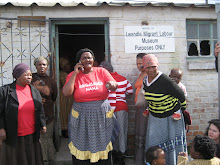
On the 1 May 2000, the day that the Museum opened, residents of Hostel 33 expressed their concern about losing accommodation and a protest sign was displayed on the door of Hotel 33 expressing residents' concerns. Leslie Witz was there and took the photograph below, recording the beginning of the Museum's struggle to assist with finding new accommodation for these residents and to secure the hostel for museum purposes.


Image of Protest sign of the sign displayed on the door of Hotel 33 by residents on the day that the LMLM opened on 1May 2000. Photograph: Leslie Witz.

In thinking about restoring Hostel 33, we have been concerned that this important struggle is somehow recorded in the exhibition at the Hostel. But the original sign has long since disappeared and all that we have is Leslie's photograph.

In this instance the team decided to remake the sign as an artifact, and artist Vivienne Gray was commissioned to do this. Using the photograph she carefully remade the sign, using similar materials - an old cardboard box - and slowly and meticulously copied the handwritten lettering in khoki pen.


Image of the reconstructed sign - 'on the drawing board' - commissioned by the LMLM's designer Jos Thorne and made by artist Vivienne Gray, 6 April 2010. Photograph: Vivienne Gray.

Once the sign was made, the team debated how to use it in the Hostel, now in 2010. Instead of securing it to the door, where it was originally displayed, it was decided that the sign will be hung inside the hostel. It has been framed (see image below), so that it is noticeably and artifact with the intention of marking this important moment on its history, and not simply reverting to the day, now almost 10 years ago, when it was first displayed.

On the 1 May 2010 the sign will be part of the new exhibition, and in this way, acknowledging the recent history of people living in Hostel 33, after 2000.

Image of the sign - remade for museum purposes by Vivienne Gray - and framed, ready to be installed in Hostel 33, 22 April 2010. Photograph: Noeleen Murray.


Lunga Smile, LMLM's Curator admires the recreated sign as new artifacts are being accessioned at the Museum, 28 April 2010. Photograph: Noeleen Murray.

Friday, April 23, 2010

Reoccupying Hostel 33

Please join the staff of Lwandle Museum and women of Lwandle in symbolically reoccupying Hostel33 - Wednesday to Friday next week 28,29 and 30th April. In preparation for the Museum's 10th birthday on 1 May 2010, the museum will be exhibiting recreated living spaces in parts of the hostel as part of the experience of visiting the Hostel. Siboniwe Tyeku, Kholiswa Ngcane and Christine Makabane will be rejoining us all of whom were present for the reenactment of the space on Women's Day in 2007.

The Museum staff and exhibition team have been very busy collecting oral histories from previous residents and many, many artifacts (such as old beds and blankets or 'irugi's shown below) and we are now ready to begin the process of re-inhabiting the space to show, in more detail, how people lived - from the time of the single sex hostels to the later periods when women and families joined men in Lwandle.

The examples below show beds and blankets from the emerging collection, some of which are original (mainly through donations), others have been specially purchased for exhibition purposes after studying photographs and in consultation with people who lived in Hostel 33 and others.

These, along with other artifacts have been accessioned and meticulously recorded by Museum Staff, Simpiwe Khonono and Mphumzi Nzuzo.


Image of an old bed - we have collected many beds through the kind donation and interest of Lwandle residents. Photograph: Noeleen Murray.

'Irugi's' - typical blankets used by residents, research courtesy Nonkululeko Gogo and Jos Thorne. Photograph courtesy: Jos Thorne.


Images of blankets purchased after research to re-create life in Hostel 33. Photograph courtesy: Jos Thorne.


'Basotho' types of blankets with decorations became more popular purchases for township dwellers in recent years, since the 1990s. Photograph courtesy: Jos Thorne.

When? 10h00 each day
Where? at Hostel 33. For directions see http://www.lwandle.com/

Buildings contain stories of everyday life

The built fabric of Hostel 33 - specifically the additions made by those who lived in the space -contains many clues to the lives of its residents as they brought back remnants from their places of work and other sources to decorate and personalise the spaces they lived in.

The Lower East Side Tenement Museum published a fascinating link this week, describing their on-going research through the respectful handling of the building and the artifacts it contains. This is a form of 'archaeology' of the site that shows how through research and continuous reflection, buildings give many clues to the stories of lives in spaces such as the Tenement Building at 97 Orchard Street New York and similarly in Hostel 33 at Lwandle.

http://www.boweryboogie.com/2010/04/tin-pan-alley-sheet-music-artifact-at-tenement-museum.html

In a similar manner there are a number of intriguing remnants emerging in Hostel 33, a selection of which are shown below. We will continue to post details such as this as we document the building.


Image from one of the partition walls at Hostel 33 showing cardboard box panels from Rainbow Chickens, wall paper pastings from Sunlight Soap bars, all nailed onto a timber superstructure with the characteristic 'bottle top' method. Photograph: Noeleen Murray.

Traces of more recent inhabitation of the Hostel post 1994, show election stickers for the African National Congress (ANC) from Nelson Mandela's time as head of the party. Photograph: Laura Davies.

There are many pages from popular magazines which were pasted onto walls inside hostel rooms, such as this one from the 1990s. Photograph: Noeleen Murray.


In all likelihood workers residing in the hostels brought home materials from their places of work in nearby industries with which to create privacy in the hostel, such as in this image or to create insulation below the ceilingless roof. Photograph: Noeleen Murray.


Some remnants can be easily dated, such as this box which forms part of a screen wall in originates in the Gants canning factory which we know was a major employer or labour from Lwandle. Photograph: Noeleen Murray.

Locating the Corobrik Hostel

While on site at Hostel 33 on Thursday 22 April 2010, long-time resident of Lwandle and ex-migrant labourer, Tembisile Madyihi visited to see progress on the restoration. We asked him about the whereabouts of the Corobrik Hostel referred to in the Urban Foundation report of 1987 and he directed us to the hostel.


Tembisile Madyihi talks to residents of the previously Corobrik Hostel (now belonging to the City of Cape Town along with the others after the Hostels-to-Homes housing project). Photograph: Noeleen Murray, 22 April 2010.

The long hostel block, now named 'Block 1', is similar in character to the rest of the hostel units but is identifiable by an ablution block at the northern end of the hostel row which, according to Madyihi, was added by Corobrik for their workers. Other workers in the old hostel compounds were forced to share ablution blocks and this was the only accommodation with its own facilities.


View of Block 1 from the South, the hostel is subtly different to the others with different windows and is slightly shorter. Photograph: Noeleen Murray, 22 April 2010.


The characteristic ablution block added by Corobrik for their workers at what is now Block 1. Photograph Noeleen Murray, 22 April 2010.


One of the old ablution blocks near Hostel 33, now used as premises for a welding business, since bathrooms were built as part of the Hostels-to-Homes Project. Photograph: Noeleen Murray, 22 April 2010.

For the rest of Lwandle's hostel dwellers communal ablution blocks were 'separate shower blocks for every four hostel buildings' (Urban Foundation Report, 1987 p.19). The report records: 'c) Dissatisfaction with the ablution facilities: Hot water is only available between 3.30am and 5.ooam, and nothing for the rest of the day.' (Urban Foundation Report, 1987, p.26). In thinking about this, we considered the difficulties of being a labourer returning from a hard day of manual work and only being able to take a cold shower in the evenings.

From talking to current residents of Block 1 it appears that some of them were labourers employed by Corobrik and the Museum will be visiting them to record their stories as part of the on-going research into hostel life at Lwandle.

Documentary Photographs

Thursday 22 April was a busy day on site at Hostel 33. In addition to glazing the windows, academic and photographer Svea Josephy joined the Museum team, to photograph the interiors of the hostel in detail as part of the on-going documentation process. Equipped with studio lights, tripods, cables and other high-spec photographic equipment, Svea was able to capture a series of photographs which reveal the interiors of the Hostel in detail. Hours were spent in this process, carefully working in the cramped conditions of the interior spaces of the hostel in setting up lighting and capturing shots which will provide the museum with a substantial photographic record of the space – as it is in April 2010 – which has been previously difficult to do with poor light. These images will form part of the Conditional Report prepared by the architects and Renchius van der Merve and the Heritage Report prepared by the Museum. Photographs will be related and annotated in detail along with the on-going large scale drawings that Renchius is preparing to accurately record the materiality of the lived space of the hostel.


Svea Josephy squeezes into a tight corner to capture the detail of Hotel 33's interior. Photograph: Noeleen Murray.

Once again Svea’s has given LMLM freely of her time, effort and creative expertise spent in doing this which is really appreciated by the Museum - she previously contributed to the Lwandle Designers Exhibition – and we are excited to have this invaluable resource to assist us in the restoration process.

Thanks are also due to Kadephi Mtiya's kind assistance in allowing us to use the electrical connection from his home across the road, as Hostel 33 awaits being rewired and reconnected to electrical supply by the City of Cape Town.

New glass for the windows

Historian Premesh Lalu’s blog comment last week asked the question ‘what is glazing?’ Well here’s the answer to his question. On Thursday 22 April the windows of Hostel 33 were reglazed – or put simply – new glass was put into the old windows. Expert glazer Errol Hendricks and his team arrived on site to do the work. Over the years glass has disappeared from the small paned windows at Hostel 33, some through vandalisation in the past by children playing and throwing stones and some from breakages caused by missing or broken clasps on the old galvanised steel windows.
February 2010, broken window panes at Hostel 33. Photograph: Laura Davies.

With winter rains coming, the Hostel was increasingly vulnerable to wind driven rain and an urgent concern in the restoration process has been the simple repair of these windows – the replacement of glass and the ironmongery of the clasps to enable the building to be properly secured. Errol Hendricks and his team – John ‘Max’ Malgarte, Japie Pretorius and Suleiman Thornton – accompanied by Lunga Smile and Renchius van der Merwe were on site to do the repairs, which provoked much interest from passers bye that came to find out what we were doing with the old building.
Glazers John 'Max' Malgarte and Error Hendricks at work on site preparing the windows for re-glazing. Photograph: Noeleen Murray.

As the team worked to clean the windows and prepare them for the new AGI N/S1 Safety Glass as specified by the architects, Lunga Smile and neighbour Kadephi Mtiya consulted neighbours who generously donated old window clasps from their own hostel-homes so that Hostel 33 would have matching original window clasps. (The Museum has replaced their own windows with newer style clasps which are commercially available).


Old ironmongery. Original window clasps were sourced by Lunga Smile from neighbours to replace those missing at Hostel 33. Photograph: Noeleen Murray.

Glazing in process - showing the new safety glass panes and the widow putty before being scraped down and finished. Photograph: Noeleen Murray.

The old steel windows proved to be in remarkably good condition despite being located near the sea, owing to the fact that they were galvanised. This enabled the glazers to install the glass with minimal intervention as no primer was needed and only the areas affected were lightly scraped to receive the glass panes and putty, affixed in a manner faithful to the original glazing techniques. This was great news as the historic character of the windows can now be left untouched, revealing layer of old paint which has peeled off over the years and no interventions around the edges of the windows and cills as these are all in good order.

Thank you to the various neighbours who donated window clasps. Their support, interest and neighbourliness in the restoration of Hotel 33 is a vital part of the sustainability of the space as a Museum. In particular Kadephi Mtiya’s initiative in watching over the Hostel, and explaining its significance to children who might otherwise vandalise the building is an example of these good relations.

Neighbour Kadephi Mtiya and Lunga Smile hand over the donated window clasps to glazer John 'Max' Malgarte who was servicing and repairing the windows. Photograph: Noeleen Murray.
The delight expressed during surprise visits by Charmion 'Mama' Plummer and Siboniwe Tyeku - previous Board Member and champion of the Museum - captured the sense of relief felt by museum staff as the windows were secured.


Charmion Plummer photographed outside Hotel 33 showing the newly glazed windows in the background. Photograph: Noeleen Murray.